Sunday, February 24, 2008

Rules: The Matt

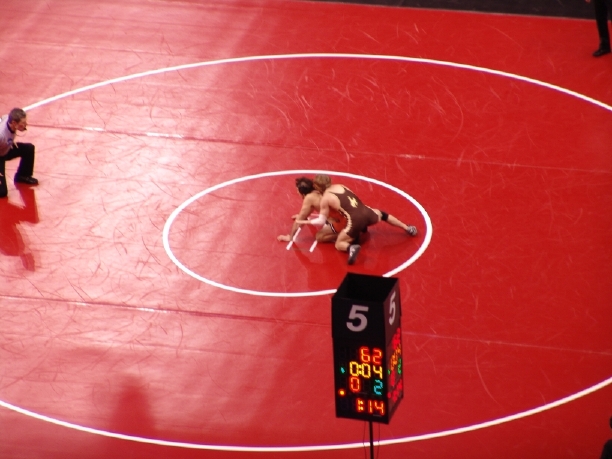
I would like to tell you guys a little bit about the basic rules of wrestling in case you are not familiar with them. It is a pretty basic competition that just takes a little bit of getting used to. Okay, first of all, the matt. The matt is a big square with a big circle, a smaller circle centered in the big circle, and a rectangle centered in the small circle.
The big circle is the out of bounds line. Whenever a majority of both wrestlers are outside this circle, the referee blows the whistle and resets the wrestlers on the rectangle. If the wresters are in a very neutral position, the referee reset them more quickly, but if one is about to score, the referee will not reset them unless they both have both their feet out (this rule often depends on the referee, some will let them go and some will reset them).
The smaller circle doesn’t really have a purpose as far as rules go, but it does let the wrestlers know where they are on the matt.
The rectangle is for the starting positions of the wrestlers. At the beginning of every match, the wrestlers start in neutral position, which is both standing up and facing each other. The other starting positions are either defensive or offensive. Defensive position is on hands and knees with the knees and hands on each of the closer lines on the rectangle. The knee placement for the offensive position is one knee down next to the defensive man, the other knee bent with the foot on the ground behind the defensive man. The hand position is one hand right above the elbow on the same side with the knee down, and the other is wrapped around the defensive man’s waist. If you are interested in the all of the NCAA's official rules and everything authentic, just click here
Next week, I will go through more of the rules, I’ll try to catch another match and write about that, and I’m thinking about doing a little “Meet the Wrestlers” section where I just go through some basic info about some of the top-ranked wresters.


Check out the Big Ten standings here.

Penn State vs. Michigan State

I got to see most of the Michigan State vs. Penn State dual meet, so I’ll start with that.
The Michigan State Spartans entered the home turf of the Nittany Lions looking to knock the Lions down a few notches from their number nine spot.
They got a good start in their first matchup at 165 pounds. Rex Kendle of Michigan State started the Spartans out with a win over Penn State’s Dave Rella. Rella was in obvious pain after cramping up in early in the first round and then had to take two more injury time outs before the bout ended. Michigan State took a 6-0 lead. This match was very slow paced and not a good start to the dual meet.
Next up were the 174 pounders, and Penn State has got a star in David Erwin, ranked 16 in his weight class in the nation. John Murphy of Michigan State was going to have his hands full. This match was much more exciting to watch. Erwin quickly got a good takedown early, and let Murphy up to his feet. Murphy chose defense for the second period and was able to escape to tie the match up. Erwin ended up winning the match by riding time, 5-4. The Spartans still had the lead 6-3.
The 184 pound match was very exciting. Phil Bomberger of Penn State barely captured the win from Nick Palmieri. The beginning of the bout was very even with several take downs and escapes. In the final round, with five seconds remaining, Palmieri seems to have the victory in the bag, but Bomberger shows a great display of effort and skill by stringing together four moves to get the takedown to win the match at the last moment. The Nittany Lions tied up the overall score 6-6. The picture is Bomberger (blue) in his last effort to win the match.
I missed the 197 pounders, the heavyweights, the 125, 133, and 141 pounders and when I returned the score was 19-13 in favor of Penn State.
Bubba Jenkins of Penn State proved his number five ranking to Eddie Skowneski in the 149 pound weight class. Skowneski kept things close in the first round, but Jenkins took over soon after. Skowneski just couldn’t find any weaknesses to exploit. Jenkins’ victory gave Penn State a lead of 22-13.
Dan Vallimont, ranked number 3 nationally at 157 pounds, took on Michigan State’s John Fulger. Vallimont was able to take down Fulger at will and racked up six takedowns. He won 15-3.
The Nittany Lions defeated the Spartans 26-13, winning 7 of 10 bouts.

Friday, February 15, 2008

Standings

I feel like I should provide some actual information on the records and standings of the teams in the Big Ten.


Wins – Losses, in the Big Ten


Iowa 5-0
Ohio State 6-1
Minnesota 4-1
Illinois 3-1
Penn State 3-3
Wisconsin 2-3
Michigan 2-3
Purdue 2-3
Northwestern 1-3
Indiana 1-5
Michigan State 0-6


As you can see, Iowa is leading up the Big Ten with an unblemished record in the conference and an 18-1 overall record. Closely behind is Ohio State and Minnesota.

According to W.I.N. wresting team rankings, Iowa is ranked number one in the nation, and nine of the top twenty teams are from the Big Ten.

My Respect for Wrestling

I would like to start by explaining the admiration I have for these men. There is no major professional wrestling league that these guys can look forward to after they graduate. They don’t have that extra push by that little voice in the back of their head saying “If I just work a little bit harder than everyone else, I could make it big as a pro and be famous one day.” Other sports such as football, baseball, basketball, hockey, etc. all have professional leagues in the United States that are the aspirations for so many collegiate athletes. I’m not saying that it is impossible for wrestlers to go into a professional field involving wrestling, there is always the Olympics and now the increasingly popular Ultimate Fighting Championship, but this is not very common.


Even with this lack of future, there is an incredible number of athletes who push themselves to the extreme to be the best wrestlers they can be. The workouts that college wrestlers go though are more intense than any other I have ever heard of. Members of my high school team would cut weight by starving themselves all day, and then doing a very high intensity work out with a sweat suit on. All that just to make weight for a meet. Then, after being starved and exhausted, they wrestle at the meet and have to be able to give full effort. Those were just my high school teammates. Serious college wrestlers are on another level entirely. I don’t know this to be true for sure, but I have heard stories of wrestlers putting on ten pounds in one night after a big wrestling meet.


I know a lot of people think of sweaty guys rubbing up on each other in tights when they hear the word wrestling. Yea, this may be partially true, they are usually sweaty and they do wear tights, but it is a very strategic game. Everyone has different strengths and weaknesses. Wrestlers examine film of their opponents to find their weaknesses in order to exploit them and get the upper hand. They also examine their own film to find their own weaknesses and work on them in practice. In a match, you may have an excellent takedown, but your opponent is very skilled on the ground. So instead of taking him down and trying to pin him, you could continuously take him down and let him get back up to get ahead in points and wear him out. Then, with the lead and a tired opponent, you are able to take more risks and go for a pin. It is a very intense sport that requires some understanding and a little bit of getting used to.


The final reason I respect wrestlers is because I used to be one and I know how strenuous it can be. Wrestling a full three round match is probably the most exhausting thing I have ever done.

Monday, February 11, 2008

Welcome to Inside the Headgear


I have recently become interested in college wrestling, specifically the Big Ten. I wrestled for one year in high school, and I really enjoyed it. I wasn't very good, but I did enjoy it. I was sitting in my dorm room, bored and neglecting my homework, when I stumbled over the Big Ten Network. There was some wrestling on, and I thought, "Oh, I know about some of this stuff, maybe I'll watch for a little while." Sure enough, I ended up watching the remainder of the dual meet, and now I check out the Big Ten Network, hoping to see some wrestling every time I watch TV.


I am by no means an expert on wrestling, so don't expect groundbreaking wrestling analysis from me. But I do know the rules (at least the high school rules), some strategy, and a few of the moves. I will do my best to provide insight on the matches that I watch, give the standings and the scores of the matches in the Big Ten, and maybe provide some background information on some of the wrestlers.