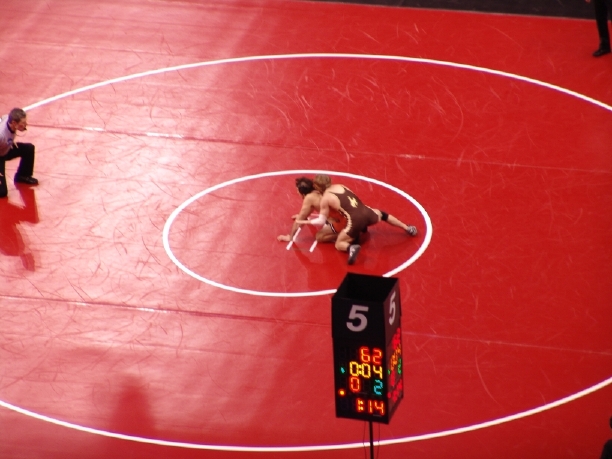
Sunday, April 6, 2008

Rules: Scoring

Scoring in wrestling is a lot different from football or baseball, but it is very simple. The four main ways of scoring are: a takedown, an escape, a reversal, or a near fall.

A takedown is when one wrestler takes his opponent from a neutral standing position to a better position on the mat. Take downs can be done in many ways. The most popular is just the single leg takedown. One wrestler shoots for his opponent’s leg, grabs it and pushes until he is on his stomach. Double-leg take downs, throws, leg picks; they are all two points.


An escape is worth one point. It happens when one wrestler has the bottom position on the mat, and is able to break away to a neutral position. An example of this would be after a takedown, the wrestler who was taken down escapes to a neutral standing position. Wrestlers who think they can easily escape from an opponent will choose to start out in the down position to score an easy point.

Reversals are less common than the first two, but they are very exciting to see. They are worth two points, just like take downs. A reversal is when one wrestler is in a defensive position on the bottom and is able to suddenly switch to a better position.

A near fall is worth three points. They happen when one wrestler is about to get a pin, but doesn’t. If the wrestler can hold his opponent close enough to being pinned for long enough, he gets three points.

Dustin Fox


Now, lets go inside the headgear of Dustin Fox, the NCAA heavyweight champion from Northwestern. He has had a very successful wrestling career at Northwestern. His collegiate stats are as follows:

Yr.; Overall; Dual
2004-05; 19-12; 6-3
2005-06; 28-11; 11-4
2006-07; 33-5; 13-2
2007-08; 29-1; 15-1
Totals; 109-29; 45-10

Fox is the 2008 Big Ten and NCAA champion in the heavyweight class. He tallied up five wins with no loses in the NCAA tournament. He scored the second most team points in the entire tournament. His 2006/2007 season was also a great year for Fox. He earned his personal collegiate best record of 33-5 and finished third in the NCAA tournament.

Dustin was born December 16, 1985 to Bill and Kym Fox in Galion Ohio. He went to high school at Galion High School and started his great wrestling career. He won two Ohio state championships, and placed three times. His high school record was 132-14. With such a successful high school career, the best teams from around the country made him offers; Ohio State, Stanford, Princeton, Virginia, and Oklahoma all took a back seat to Northwestern. He based his decision on the great education along with the Big Ten’s accolades in wrestling, Northwestern was the obvious choice. He also knew a guy from high school that was going there. He is grateful for his decision because he loves Chicago, especially the concerts. During his free time, Fox likes to go see movies and concerts with his friends. If he wasn’t a wrestler, he would like to make movies. He’s a film major so some day, maybe he will.

Fox’s championship match was a very interesting and exciting to watch. His opponent, J.D. Bergman from Ohio State, was a good friend of his in high school. He knew him for a long time and they always wrestled on the same team. They never met in a real match until college. Fox said it was weird because he was so used to practicing him in high school, and now it’s the biggest stakes with the most on the line. Fox also said about the championship match that he didn’t want to get too nervous before. A lot of people can’t appreciate the moment that they have been waiting for their whole lives because they are too nervous. Fox didn’t let that happen. He sat back, relaxed and enjoyed his accomplishment.

The match itself was entertaining as well. It went into two overtime periods. The first overtime was very action packed. Fox gets an incidental head but in the first to stop up the action and tend to his bloody nose. A bloody nose that goes nicely with his cut forehead and busted headgear. Bergman chooses the down position at the beginning of the second overtime period. Bergman charges up and breaks away from Fox to take a one point lead. Fox then takes the down position and escapes immediately to tie the score. In the final one minute round, Fox blocks a desperate shoot from Bergman and retaliates with his own. Fox is able to control Bergman’s leg and takes him down for two points and the victory. Watch the overtime periods here

See some Dustin Fox interviews at flowrestling.com


Sunday, March 30, 2008

Iowa's Great Success This Year

Iowa has really had a great season of wrestling. Brent Metcalf at 159 pounds and Mark Perry at 165 pounds each won their weight class. Those two pushed the team to a 38.5 victory margin. This championship is their first as a team in eight years. Brent Metcalf says, “the program is building, and its working toward dominance,” speaking of the current Iowa team. Metcalf will be a junior next year and will play an important role in their success. Metcalf beat Bubba Jenkins of Penn State for the championship at a score of 14-8. He trailed early, but came back for the win.

NCAA Tournament Individual Results


The Big Ten also did very well in the individual championships.

125: #1 Angel Escobedo, Indiana – W, 8-3 dec.
#2 Jayson Ness, Minnesota
133: #3 Coleman Scott, Oklahoma State – WBF (0:49)
#4 Joey Slaton, Iowa
141: #6 J Jaggers, Ohio State – W, 5-2 dec.
#1 Chad Mendes, Cal Poly
149: #1 Brent Metcalf, Iowa – W, 14-8 dec.
#6 Bubba Jenkins, Penn State
157: #8 Jordan Leen, Cornell – W, 5-4 dec.
#2 Mike Poeta, Illinois
165: #2 Mark Perry, Iowa – W, 5-2 dec.
#1 Eric Tannenbaum, Michigan
174: #1 Keith Gavin, Pittsburgh – W, 4-2
#2 Steve Luke, Michigan
184: #2 Mike Pucillo, Ohio State – W, 3-3 dec. (tb; rt)
#1 Jake Varner, Iowa State
197: #2 Phil Davis, Penn State – W, 7-2 dec.
#4 Wynn Michalak, Central Michigan
HWT:#1 Dustin Fox, Northwestern – W, 4-2 (sv) dec.
#2 J.D. Bergman, Ohio State

Seven of the ten champions were Big Ten wrestlers. Northwestern, Iowa, Ohio State, Penn State, and Indiana all had champion wreslters. Any match that didn't have a Big Ten wrestler winning, had one losing. Every championship match was represented by either a winner, loser, or both from the Big Ten. That is awesome.

NCAA Tournament team results


The NCAA championship was held in St. Louis on March 20, 21, 22. The final team results are as follows:
NCAA TEAM STANDINGS - TOP 10 TEAMS
Place Team Points Finalists
1. Iowa 109.5 3
2. Nebraska 74 0
3. Iowa State 72 1
4. Ohio State 71 3
Penn State 71 2
6. Central Michigan 69 1
Michigan 69 2
8. Oklahoma State 66 1
9. Cornell 63 1
10. Minnesota 61.5 1

As you can clearly see, Iowa went on to win the NCAA championship right after their Big Ten victory. You can also notice how many Big Ten teams are up there; Iowa, Ohio State, Penn State, Michigan, and Minnesota. That’s the top half of the Big Ten.

Responce to the New Weight Method


I thought the test was very effective. They found a faster, more accurate and, more comfortable method for weighing and determining wrestler's lowest wrestling weight. The tests they ran on the college wrestlers were done right and were very effective. The NCAA should start using it some time soon. A more accurate method ensures the safety of the wrestlers. Dropping below a certain percent body fat is not safe, and can have negative effects on the body. Keeping people safe and making their lives easier; thats just a good test.

Sunday, March 23, 2008

Results of the Big Ten Tournament


The Big Ten tournament was held on March 8 and 9 in Minnesota. Iowa wins by a landslide with a final team score of 127. The Minnesota Gophers wound up in second with a score of 112.5. Michigan claimed the third spot with 97.5 team points. Illinois ended with 94, good enough for fourth. The Buckeyes 92.5 points earned them fifth place. Wisconsin scored 85.5 and ended in sixth. The Nittany Lions took seventh with 84.5. Indiana scored 80 points for an eighth place finish. Northwestern finished with 80 points as well for a ninth place finish. Purdue scored 51.5 points putting them ahead of only the Spartans, who rounded out the scoring with 34.
The championship matches went as follows.
125 - #3 Angel Escobedo (IND) defeated #1 Jayson Ness (MINN), 4-2
The first round went scoreless. Escobedo scored two points for a reversal in the second. Ness scored a reversal in the third period to tie it. Escobedo got an escape and the riding time point to win the match
133 - #3 Franklin Gomez (MSU) defeated #1 James Kennedy (ILL), 3-1
In the first, Gomez scored two points for a takedown, and had an escape in the second. Kennedy’s only point came from an escape in the third period.
141 - #1 Kellen Russell (MICH) defeated #6 Manuel Rivera (MINN), 3-2
Russel scored a takedown and Rivera escaped in the first round. Russel got an escape in the second to take a 3-1 lead. Rivera’s efforts in the final round came up short with just an escape.
149 - #1 Brent Metcalf (IOWA) defeated #2 Dustin Schlatter (MINN), 5-3
The first round favored Schlatter with a takedown while Metcalf only had an escape. Metcalf tied it up with another escape in the second. Schlatter got an escape early in the third to take the lead, but Metcalf retaliated with a takedown and got a stalling point to pull out the win.
157 - #1 Michael Poeta (ILL) defeated #2 Dan Vallimont (PSU), 8-2
The first period went scoreless. Poeta scored three in the second with an escape and a takedown. The third period was filled with scoring. Poeta had two takedowns and earned the riding point. Vallimont escaped twice for two points.
165 - #2 Eric Tannenbaum (MICH) defeated #1 Mark Perry (IOWA), 3-2
Tennenbaum scored a takedown, but was penalized for locked hands shortly after putting the score at 2-1. A Perry escape tied it up for the second. The second and third periods went scoreless, and Tennenbaum won with riding time.
174 - #1 Steve Luke (MICH) defeated #3 Gabriel Dretsch (MINN), 5-3
Luke scored two takedowns and Dretsch escaped twice in the first. Dretsch scored one escape in the second. In the third, Luke escaped and earned the riding time.
184 - #1 Mike Pucillo (OSU) defeated #2 Tyrel Todd (MICH), 4-3
The first period went scoreless. Pucillo scored an escape followed by a Todd takedown in the second. Todd followed up with an escape in the third, but lost a violation point. Pucillo scored a takedown to finish out the match.
197 - #2 Phil Davis (PSU) defeated #1 Mike Tamillow (NU), 3-2
The first went scoreless. Davis scored an escape and a takedown in the second. Tamillow earned an escape in the second. Tamillow escaped in the third and David ended with riding time.
Hwt - #2 Dustin Fox (NU) defeated #1 J.D. Bergman (OSU), 2-0
The first period went scoreless. Fox scored an escape in the second. No scoring in the third, and Fox earned the riding time point.

New Method for Weight Management


Unhealthy weight loss leads to unsafe participation in matches. A minimum wrestling weight is determined at the beginning of the wrestling season by body weight, body composition, and specific gravity of urine. The weight is determined by finding the wrestler’s mass without any fat plus five percent for fat. Five percent body fat is the lowest healthy percent, so when cutting weight for a match, the wrestler will not be able to go below five percent and still wrestle. Currently, the NCAA uses hydrostatic weighing together with skin folds for determining the lowest wrestling weight. These methods are not always very accurate. New methods have been developed such as air displacement plethysmography. Air displacement plethysmography is a densitometric method that relies on measurement of mass and volume to calculate body density. Densitometry is the measurement of density by measuring the time a projected wave takes to go out and return to a sensor. Advantages of air displacement plethysmography are it requires less technical expertise, it is more efficient and comfortable than hydrostatic weighing. Testing showed that air displacement plethysmography had very similar results to hydrostatic weighing, but some major variations cause questions. The study evaluated the accuracy of air displacement plethysmography for measuring body density compared to the current method. The study included 66 division 1 collegiate wrestlers, some from each weight class. In a hydrated and dehydrated state, air displacement plethysmography and current tests were similar.


Utter, Alan C., Fredric L. Goss, and Pamela D. Swan. "Evaluation of Air Displacement for Assessing Body Composition of Collegiate Wrestlers." Medicine and Science in Sports and Exercise 35.3 (2003): 500-5.

Sunday, March 2, 2008

Brent Metcalf


Today, I’ll let you inside the headgear of the number one ranked wrestler in the nation at 149 pounds; Brent Metcalf, a sophomore at Iowa.

Brent was born on July 14, 1986 in Davison Michigan to Tom and Lynn Metcalf. Davison is a small town of about 5,000 people in eastern Michigan. He attended the public high school of 1,500 students. Brent had a successful wrestling career with the Davison Cardinals. He went 228-0 during his four years. He won four individual state championships and led his teammates to four team state championships. To go four straight years without losing is simply amazing. It takes total commitment and determination which includes endless hours of practice and working out to accomplish such a feat.

He picked up wrestling around the age of eight. He didn’t start because his dad made him, or because he loved Hulk Hogan. He started wrestling because he found a paper at his school with the mascot wearing a singlet (the spandex uniforms they wear during a match) and thought it was cool. His involvement got the whole family interested. His father started attending his matches and his older brother dropped basketball and picked up the intense sport. His whole family was hooked.

He and his brother loved wrestling because it took their fighting around the house, and made it into a real competition. His brother is one of the reasons that he is so successful today. He would always push Brent to the edge. He would make him stay after practice to work out and help him improve his technique. They had a very strong connection that really helped him become the best wrestler he could become. Since then, his brother passed away, and Brent seems to honor him through his great wrestling career and hard working attitude.

Before his high school career began, Brent would go and watch his brother, so he fell right into the groove once he entered high school. His high school coach, Roy Hall, influenced his career greatly. Roy Hall instilled in Brent the mindset that has made him the successful collegiate wrestler that he is today. Brent says that he goes into every match expecting to win. This mindset has done Brent well in the collegiate level as well. He is currently a sophomore and is ranked number one in the nation with a record of 30-1.

Check out this website if you want to see some interviews with him. FloWrestling


Sunday, February 24, 2008

Rules: The Matt

I would like to tell you guys a little bit about the basic rules of wrestling in case you are not familiar with them. It is a pretty basic competition that just takes a little bit of getting used to. Okay, first of all, the matt. The matt is a big square with a big circle, a smaller circle centered in the big circle, and a rectangle centered in the small circle.
The big circle is the out of bounds line. Whenever a majority of both wrestlers are outside this circle, the referee blows the whistle and resets the wrestlers on the rectangle. If the wresters are in a very neutral position, the referee reset them more quickly, but if one is about to score, the referee will not reset them unless they both have both their feet out (this rule often depends on the referee, some will let them go and some will reset them).
The smaller circle doesn’t really have a purpose as far as rules go, but it does let the wrestlers know where they are on the matt.
The rectangle is for the starting positions of the wrestlers. At the beginning of every match, the wrestlers start in neutral position, which is both standing up and facing each other. The other starting positions are either defensive or offensive. Defensive position is on hands and knees with the knees and hands on each of the closer lines on the rectangle. The knee placement for the offensive position is one knee down next to the defensive man, the other knee bent with the foot on the ground behind the defensive man. The hand position is one hand right above the elbow on the same side with the knee down, and the other is wrapped around the defensive man’s waist. If you are interested in the all of the NCAA's official rules and everything authentic, just click here

Next week, I will go through more of the rules, I’ll try to catch another match and write about that, and I’m thinking about doing a little “Meet the Wrestlers” section where I just go through some basic info about some of the top-ranked wresters.


Check out the Big Ten standings here.

Penn State vs. Michigan State

I got to see most of the Michigan State vs. Penn State dual meet, so I’ll start with that.
The Michigan State Spartans entered the home turf of the Nittany Lions looking to knock the Lions down a few notches from their number nine spot.
They got a good start in their first matchup at 165 pounds. Rex Kendle of Michigan State started the Spartans out with a win over Penn State’s Dave Rella. Rella was in obvious pain after cramping up in early in the first round and then had to take two more injury time outs before the bout ended. Michigan State took a 6-0 lead. This match was very slow paced and not a good start to the dual meet.
Next up were the 174 pounders, and Penn State has got a star in David Erwin, ranked 16 in his weight class in the nation. John Murphy of Michigan State was going to have his hands full. This match was much more exciting to watch. Erwin quickly got a good takedown early, and let Murphy up to his feet. Murphy chose defense for the second period and was able to escape to tie the match up. Erwin ended up winning the match by riding time, 5-4. The Spartans still had the lead 6-3.
The 184 pound match was very exciting. Phil Bomberger of Penn State barely captured the win from Nick Palmieri. The beginning of the bout was very even with several take downs and escapes. In the final round, with five seconds remaining, Palmieri seems to have the victory in the bag, but Bomberger shows a great display of effort and skill by stringing together four moves to get the takedown to win the match at the last moment. The Nittany Lions tied up the overall score 6-6. The picture is Bomberger (blue) in his last effort to win the match.
I missed the 197 pounders, the heavyweights, the 125, 133, and 141 pounders and when I returned the score was 19-13 in favor of Penn State.
Bubba Jenkins of Penn State proved his number five ranking to Eddie Skowneski in the 149 pound weight class. Skowneski kept things close in the first round, but Jenkins took over soon after. Skowneski just couldn’t find any weaknesses to exploit. Jenkins’ victory gave Penn State a lead of 22-13.
Dan Vallimont, ranked number 3 nationally at 157 pounds, took on Michigan State’s John Fulger. Vallimont was able to take down Fulger at will and racked up six takedowns. He won 15-3.
The Nittany Lions defeated the Spartans 26-13, winning 7 of 10 bouts.

Friday, February 15, 2008

Standings

I feel like I should provide some actual information on the records and standings of the teams in the Big Ten.


Wins – Losses, in the Big Ten


Iowa 5-0
Ohio State 6-1
Minnesota 4-1
Illinois 3-1
Penn State 3-3
Wisconsin 2-3
Michigan 2-3
Purdue 2-3
Northwestern 1-3
Indiana 1-5
Michigan State 0-6


As you can see, Iowa is leading up the Big Ten with an unblemished record in the conference and an 18-1 overall record. Closely behind is Ohio State and Minnesota.

According to W.I.N. wresting team rankings, Iowa is ranked number one in the nation, and nine of the top twenty teams are from the Big Ten.

My Respect for Wrestling

I would like to start by explaining the admiration I have for these men. There is no major professional wrestling league that these guys can look forward to after they graduate. They don’t have that extra push by that little voice in the back of their head saying “If I just work a little bit harder than everyone else, I could make it big as a pro and be famous one day.” Other sports such as football, baseball, basketball, hockey, etc. all have professional leagues in the United States that are the aspirations for so many collegiate athletes. I’m not saying that it is impossible for wrestlers to go into a professional field involving wrestling, there is always the Olympics and now the increasingly popular Ultimate Fighting Championship, but this is not very common.


Even with this lack of future, there is an incredible number of athletes who push themselves to the extreme to be the best wrestlers they can be. The workouts that college wrestlers go though are more intense than any other I have ever heard of. Members of my high school team would cut weight by starving themselves all day, and then doing a very high intensity work out with a sweat suit on. All that just to make weight for a meet. Then, after being starved and exhausted, they wrestle at the meet and have to be able to give full effort. Those were just my high school teammates. Serious college wrestlers are on another level entirely. I don’t know this to be true for sure, but I have heard stories of wrestlers putting on ten pounds in one night after a big wrestling meet.


I know a lot of people think of sweaty guys rubbing up on each other in tights when they hear the word wrestling. Yea, this may be partially true, they are usually sweaty and they do wear tights, but it is a very strategic game. Everyone has different strengths and weaknesses. Wrestlers examine film of their opponents to find their weaknesses in order to exploit them and get the upper hand. They also examine their own film to find their own weaknesses and work on them in practice. In a match, you may have an excellent takedown, but your opponent is very skilled on the ground. So instead of taking him down and trying to pin him, you could continuously take him down and let him get back up to get ahead in points and wear him out. Then, with the lead and a tired opponent, you are able to take more risks and go for a pin. It is a very intense sport that requires some understanding and a little bit of getting used to.


The final reason I respect wrestlers is because I used to be one and I know how strenuous it can be. Wrestling a full three round match is probably the most exhausting thing I have ever done.

Monday, February 11, 2008

Welcome to Inside the Headgear


I have recently become interested in college wrestling, specifically the Big Ten. I wrestled for one year in high school, and I really enjoyed it. I wasn't very good, but I did enjoy it. I was sitting in my dorm room, bored and neglecting my homework, when I stumbled over the Big Ten Network. There was some wrestling on, and I thought, "Oh, I know about some of this stuff, maybe I'll watch for a little while." Sure enough, I ended up watching the remainder of the dual meet, and now I check out the Big Ten Network, hoping to see some wrestling every time I watch TV.


I am by no means an expert on wrestling, so don't expect groundbreaking wrestling analysis from me. But I do know the rules (at least the high school rules), some strategy, and a few of the moves. I will do my best to provide insight on the matches that I watch, give the standings and the scores of the matches in the Big Ten, and maybe provide some background information on some of the wrestlers.